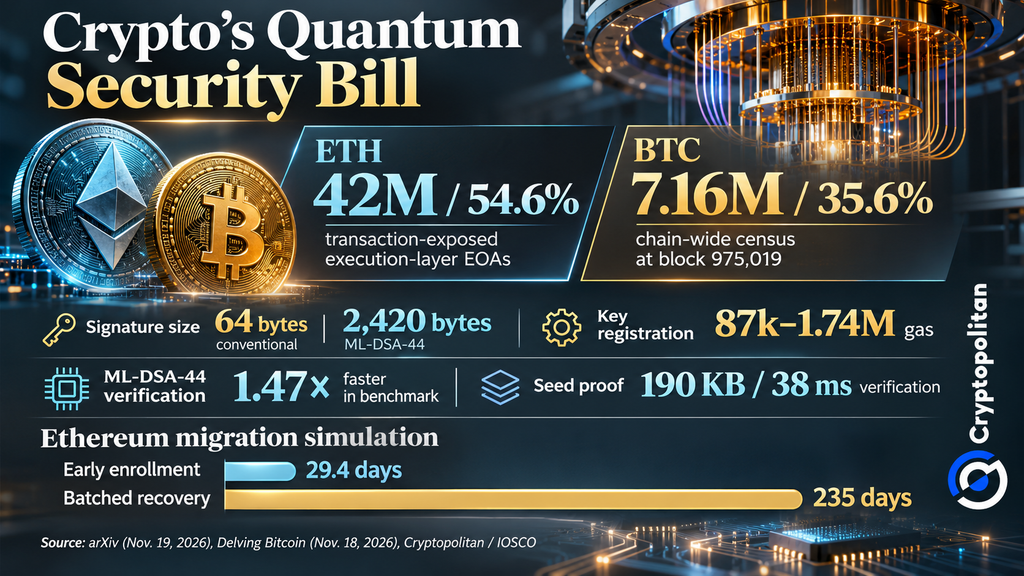
As reported on November 24, 2026, two studies conducted that November estimated how much cryptocurrency sits in a position a future quantum computer could attack: about 42 million ETH and 7.16 million BTC. Those figures are not reports of thefts underway. They measure how widely public keys are already visible, and therefore how large an industry-wide move to quantum-resistant storage would have to be. For exchanges, custodians, and investors, the open questions are the cost of that move and what it would mean for transaction fees, liquidity, and market confidence.
What an exposed key changes
On Ethereum, the first transaction from an account reveals enough signature data for an observer to derive the account’s public key. That public key is mathematically tied to the private key that authorizes spending. Research from the University of Pittsburgh and the Chicago security firm SeQure treats that link as a future risk: a sufficiently powerful quantum computer running Shor’s algorithm could, in principle, recover the private key and take the funds.
Accounts that have never signed a transaction are described as less exposed. As Ethereum explains it, those addresses publish only a hash of the public key, not the key itself. The studies are about that future cryptographic break, not about losses already caused by quantum machines. Separate from that, an August 2026 USENIX study recorded monetary losses tied to compromised keys and other misuse of blockchain addresses, showing that key-compromise harm is already observable by ordinary means.
Two estimates, two methods
The ETH and BTC totals are not the same measurement.
The Ethereum work looked at externally owned accounts, which are controlled by private keys rather than by smart contracts. Accounts that had already revealed public keys through transactions held about 42 million ETH, or 54.6% of the ETH on Ethereum’s execution layer.
A Bitcoin census published on November 18 examined the chain through block 975,019. It found about 7.16 million BTC in outputs with exposed public keys or spending scripts, equal to 35.6% of unspent bitcoin. Glassnode, a blockchain analytics firm, separately reported that bitcoin it classifies as vulnerable to a future quantum attack rose from 6.04 million BTC in May to 7.12 million BTC on November 10. That Glassnode series is not the same figure as the November 18 census.

A proposed Ethereum path, not an activated upgrade
Because so much ETH is in accounts with revealed keys, the Pittsburgh-led study argues for moving those funds into quantum-resistant storage. Its design is a research proposal, not an adopted Ethereum Improvement Proposal, a client release, or a change live on the network.
The proposal would let users register quantum-resistant keys before Ethereum retired its current signature scheme. Anyone who missed that deadline could still recover an account by submitting a cryptographic proof of ownership based on the wallet recovery phrase. Researchers simulated that process for 4.45 million accounts holding at least 0.1 ETH. If every owner registered early, the modeled migration took 29.4 days. If every owner instead recovered after the deadline, it took 235 days. The binding limit in the simulation was block space: each recovery proof was about 190 KB of data and took about 38 milliseconds to verify.
Those durations describe the simulation under two extreme participation assumptions. They are not a scheduled network upgrade, and they depend on when account owners act.
Ethereum’s roadmap goal, as described in the report, is full quantum resistance by December 2029. That date is a stated goal, not confirmation that resistance is active. On November 19, Ethereum developers discussed shrinking the Hegotá upgrade as a way to move faster toward that goal. The report records a discussion, not a decision that Hegotá had been reduced or that a quantum migration had been scheduled inside it.
Bitcoin’s narrower draft
Bitcoin’s discussion is more incremental, and it is also still at proposal stage. Draft BIP-360 would add Pay-to-Merkle-Root, a receive path that does not expose a public key when funds arrive. Spending could still reveal the key. Shielding transactions while they wait for confirmation would need further changes to Bitcoin’s signature system; BIP-360 alone is not described as doing that.
Coinbase, which says it holds about 12% of bitcoin supply, has suggested a gradual transition in which users could sign with either conventional or quantum-resistant signatures. That is a suggested transition, not an activated consensus rule.
Where the cost shows up
Signature size is the practical constraint. A conventional elliptic-curve signature is about 64 bytes. ML-DSA-44, a standardized quantum-resistant alternative, is 2,420 bytes. Size and verification time do not move together: in one benchmark, ML-DSA-44 verification was 1.47 times faster than Ethereum’s conventional ECDSA verification.
Registration can still be expensive. Research tests on Ethereum recorded costs from 87,000 to 1.74 million gas to register new keys. On November 19, the International Organization of Securities Commissions warned that larger signatures could cut network capacity and raise fees. An experimental Solana testnet saw transaction-processing capacity fall by roughly 90%, though the report says that result does not necessarily describe Solana’s main network.
Institutions are early in their own planning. A November risk assessment by the European Banking Authority found that only 8% of banks surveyed had successful plans to move to quantum-resistant cryptography. For exchanges and custodians, the operational issue is broader than swapping algorithms: moving large balances at the same time could raise settlement costs, and liquidity could thin if sizable holdings were temporarily unreachable during a migration.
None of the Ethereum or Bitcoin signature changes described above is reported as activated. The exposed-key totals are inventory of a future risk; the day counts, gas ranges, and capacity figures are study results and warnings, not live fee schedules.