
As reported on November 18, 2026, Pierre, a member of the Ethereum Foundation’s privacy research effort, announced a working group focused on stealth addresses. The reported participants include the Ethereum Foundation, Umbra developer ScopeLift, stealth-address wallet Fluidkey and hardware-wallet maker Trezor. The group plans to meet every two weeks.
The work centers on ERC-5564, a standard for receiving funds through stealth addresses. The group proposes a hybrid approach combining existing elliptic-curve cryptography with ML-KEM, a lattice-based key-encapsulation mechanism, to address the risk of future quantum computers tracing historical transfers. It also plans a separate reference implementation and code audits as steps toward moving the ERC to Final status. The report does not say that the ERC has reached that status or that the proposed cryptographic changes have been deployed.
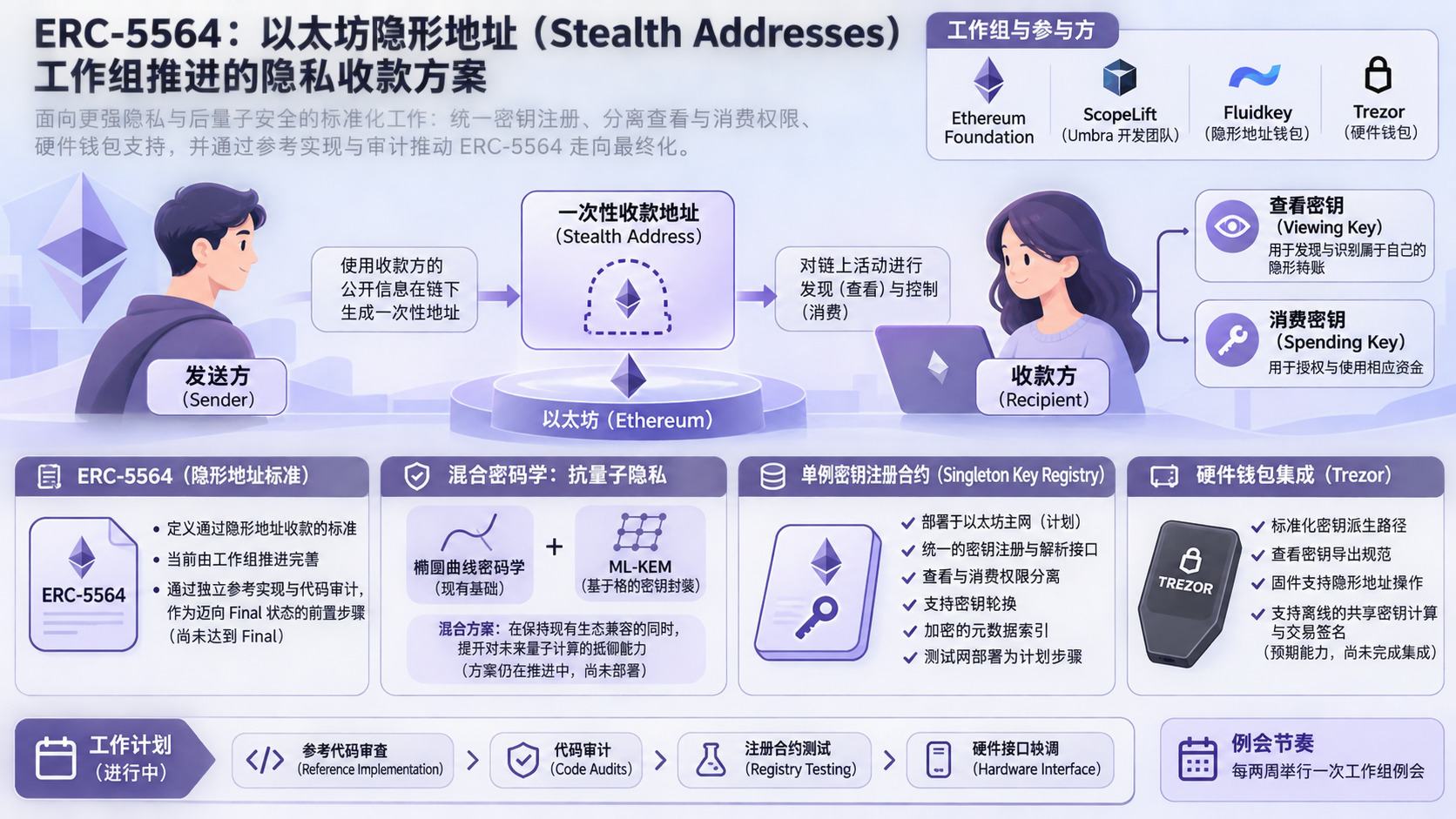
For use across applications, the group plans a singleton key registry contract on Ethereum mainnet. The proposed shared interface would let users register and resolve stealth-address keys without publishing a stealth meta-address separately in each application. The design described in the report also separates spending and viewing permissions and provides for key rotation and encrypted metadata indexing. Testnet deployment remains a planned step.
The hardware-wallet effort with Trezor aims to standardize key-derivation paths and viewing-key export, alongside firmware support for stealth-address operations. The report describes offline shared-key computation and transaction signing as intended capabilities, not completed integrations. Reference-code review, registry testing and hardware-interface coordination remain on the group’s work plan.