As reported on November 18, 2026, Ethereum’s post-quantum work was moving from a theoretical security concern toward protocol engineering. The immediate question was not whether users needed to move their assets—the article said no cryptographically capable quantum computer had emerged—but how Ethereum could change its cryptography without leaving accounts, validators and applications behind.
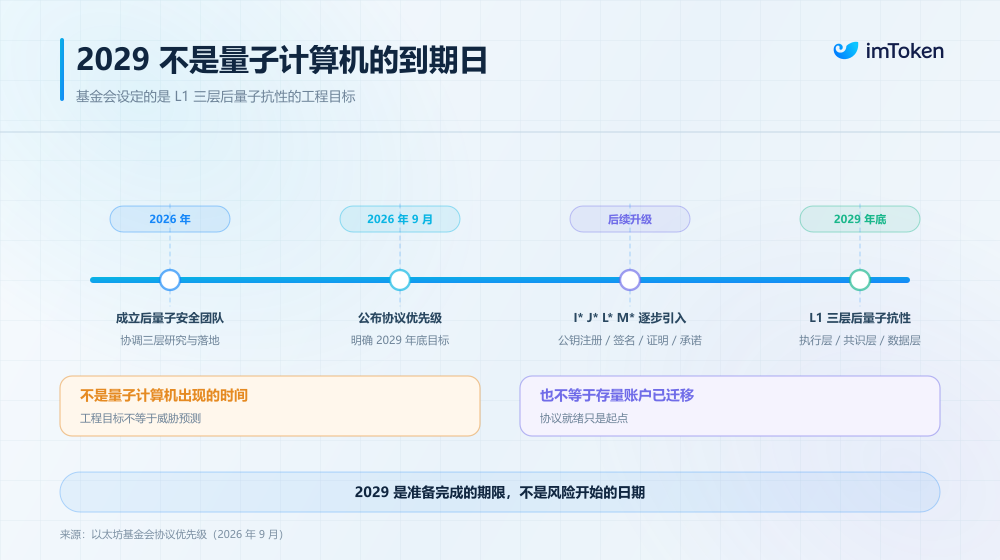
The Ethereum Foundation’s protocol priorities published in September 2026 set an engineering goal, not an activated upgrade: make Ethereum L1 post-quantum resistant across its execution, consensus and data layers by December 2029. The proposed components and migration paths still require further work.
Why the risks differ
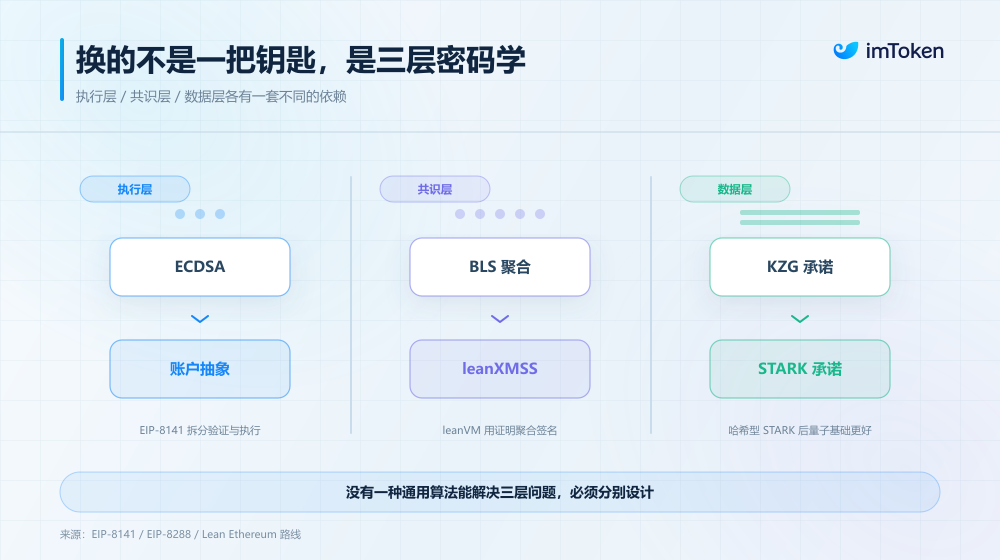
Ethereum uses different cryptographic tools for different jobs. Ordinary externally owned accounts (EOAs) use ECDSA signatures; proof-of-stake validators use BLS signatures, whose aggregation helps handle many votes. KZG polynomial commitments support blob and rollup data availability, while rollups and other applications use various zero-knowledge proof systems.
The concern is that a sufficiently capable, fault-tolerant quantum computer running Shor’s algorithm could undermine the elliptic-curve assumptions behind ECDSA and BLS. The article also identifies potential long-term implications for KZG and for proof systems that rely on elliptic-curve pairings. Hash-based tools have a different risk profile: Grover’s algorithm offers a quadratic speedup against hash functions such as Keccak-256, rather than the same kind of attack Shor’s algorithm poses to elliptic-curve cryptography.
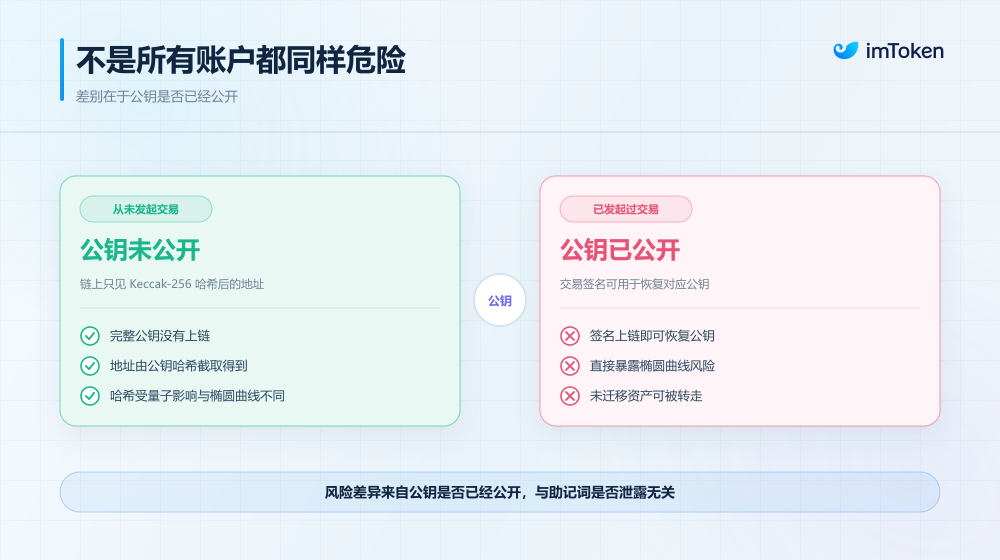
Exposure also differs between accounts. An ordinary Ethereum address is derived from a hashed public key. If an account has never sent an on-chain transaction or disclosed an off-chain signature, its full public key has not been revealed in those ways. Once it has signed a public transaction, the signature can expose the public key. That distinction matters to a future attack capable of deriving a private key from a public one; it is not a reason for users to make a hurried transfer now.
Three layers, different proposed tools
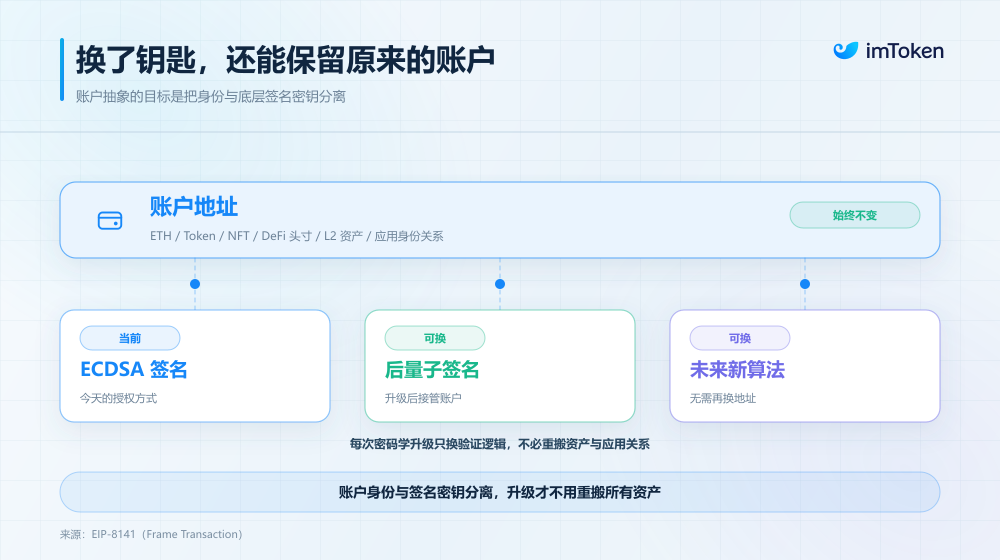
Execution and accounts. A conventional EOA ties authorization to a secp256k1 key and ECDSA verification. EIP-8141, discussed as a proposal, would separate transaction validation, execution and gas payment into programmable steps. That could give accounts room to change validation rules and, potentially, rotate to different signature schemes without always changing account identity. The article also describes research into post-quantum signature-verification precompiles. Neither a proposed EIP nor research into a precompile is an activated network change.
Larger post-quantum signatures create a separate cost problem. EIP-8288 proposes recursive STARK aggregation to compress the results of verifying many such signatures into a more compact proof, reducing the data and verification burden on-chain.
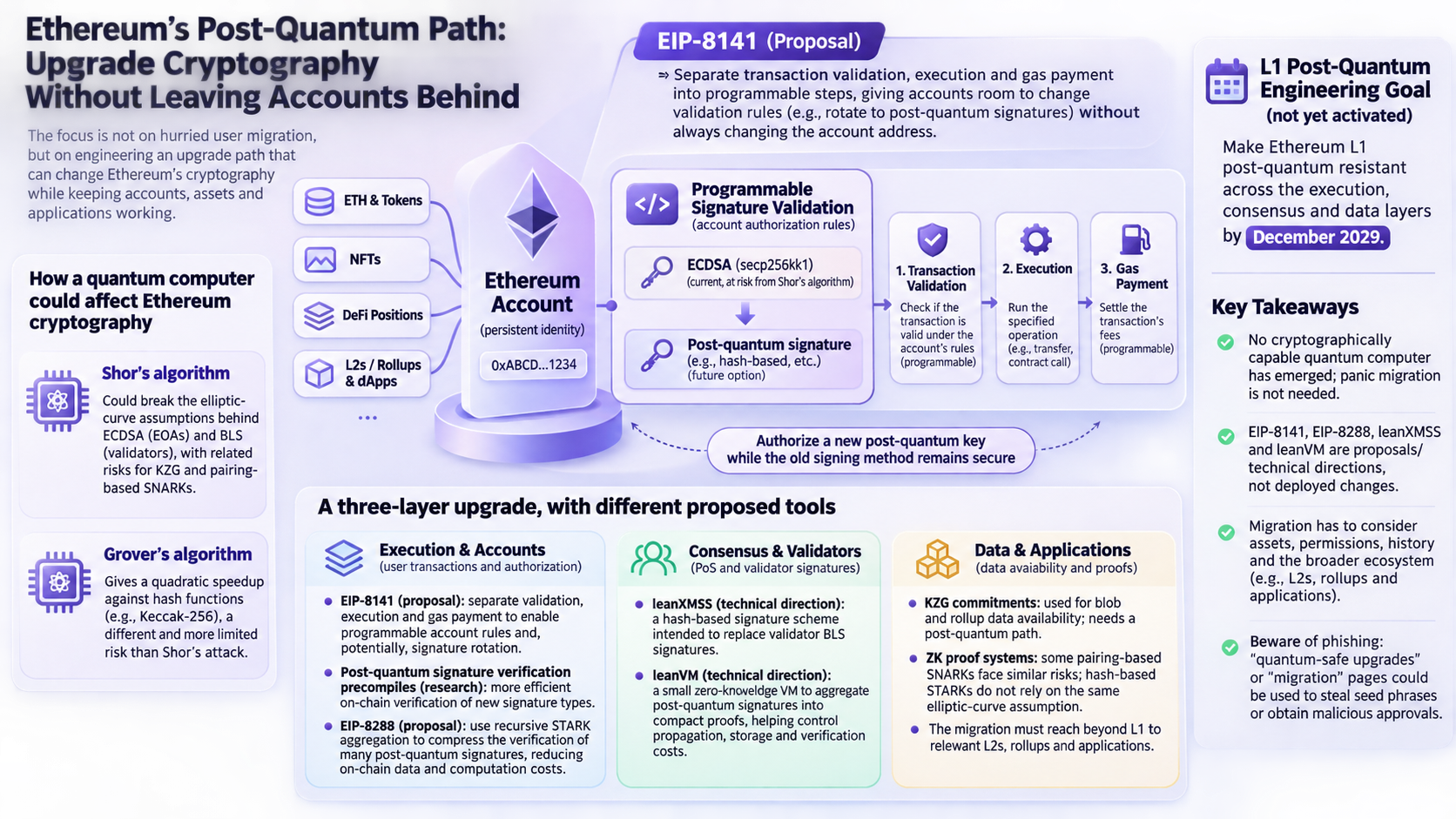
Consensus and validators. Replacing BLS signatures directly with much larger signatures could raise peer-to-peer propagation, storage and verification costs. The Lean Ethereum directions described in the article include leanXMSS, a hash-based signature approach intended to replace validator BLS signatures, and leanVM, a proposed small zero-knowledge virtual machine intended to aggregate post-quantum signatures into compact proofs. These are technical directions, not changes already deployed to validators.
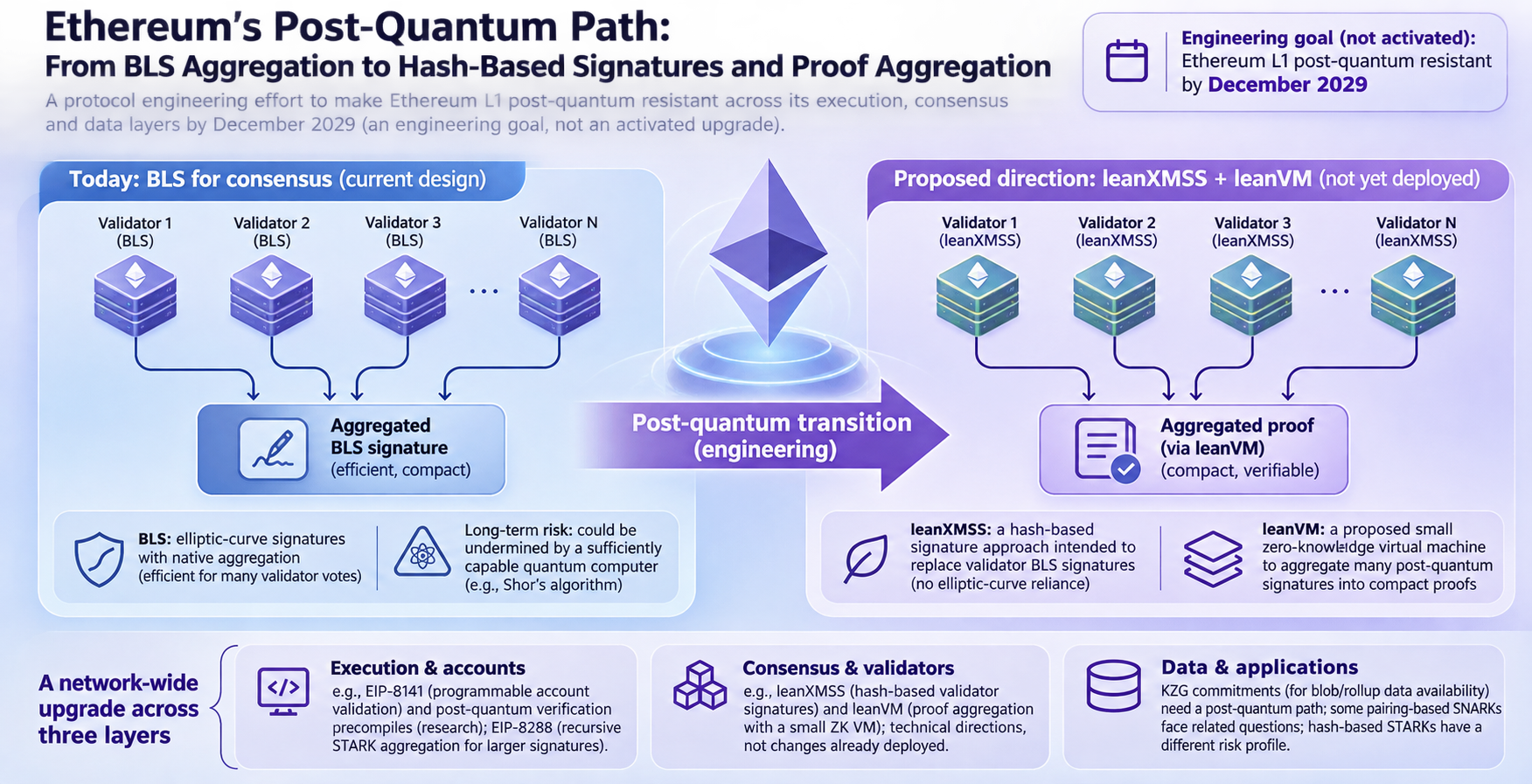
Data and applications. KZG commitments, used in the blob and rollup data-availability context, also need a post-quantum path. Some pairing-based SNARKs used by applications face related questions; hash-based STARKs do not depend on the same elliptic-curve discrete-log assumption. Any migration must therefore reach beyond L1 to relevant L2s, rollups and applications.
The account-migration problem
Changing a key is not necessarily the same as preserving an account. An address can be associated with ETH, tokens, NFTs, DeFi positions and assets on multiple L2s, as well as application permissions and history. Programmable account validation could, in principle, let a user change the underlying authorization method while retaining an account address. That outcome depends on the eventual design and on how existing accounts and applications migrate; EIP-8141 does not by itself guarantee it for every account.
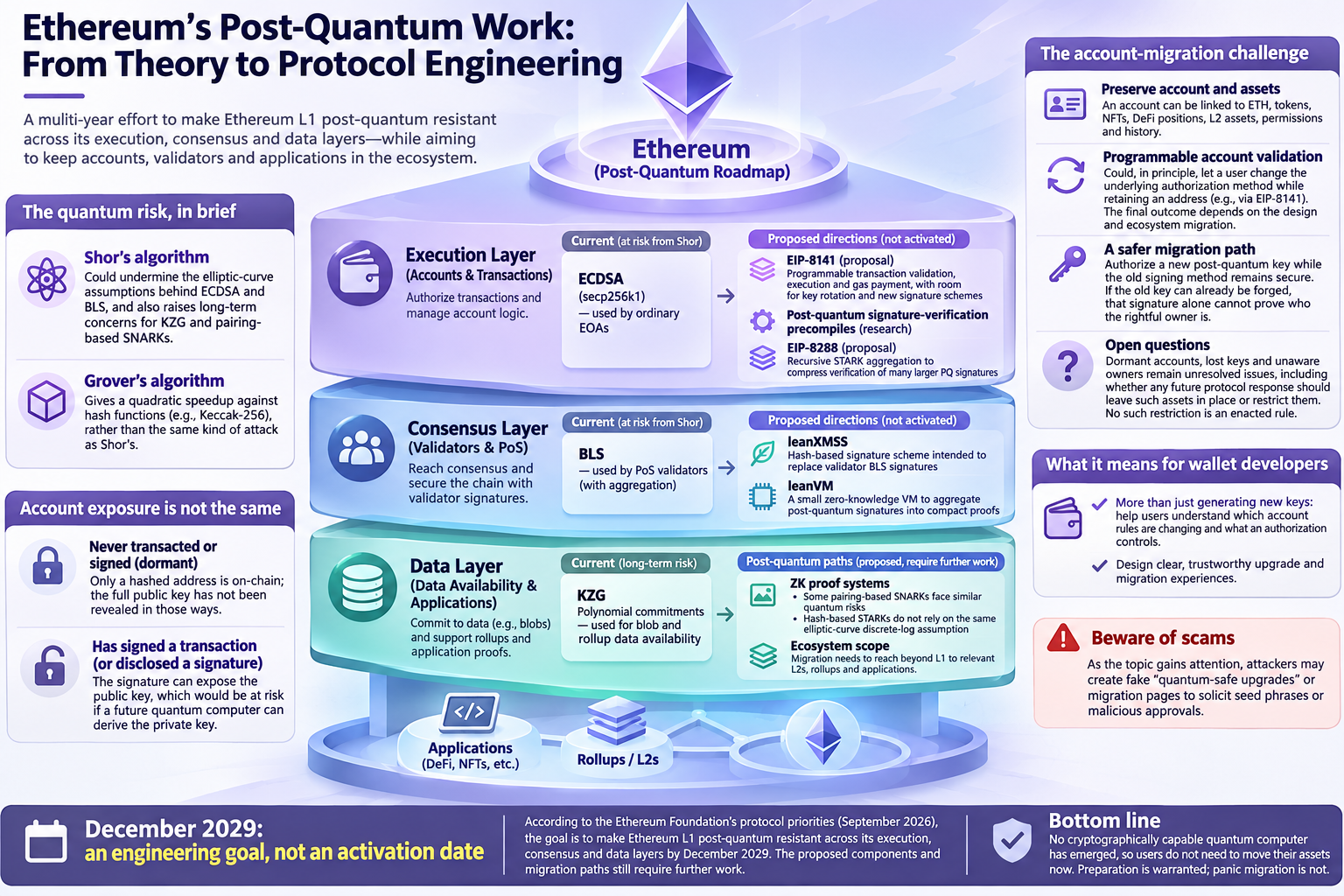
The safest prospective path described in the article is to authorize a new post-quantum key while the old signing method remains secure. If an attacker can already forge signatures from the old key, that signature alone cannot establish who the rightful owner is. Dormant accounts, lost keys and owners unaware of a migration raise harder unresolved questions, including whether any future protocol response should leave such assets in place or restrict them. No such restriction is presented as an enacted rule.
For wallet developers, the work is consequently about more than generating new keys: users would need to understand which account rules are changing and what an authorization controls. The article also warns that purported “quantum-safe upgrades” or migration pages could be used to solicit seed phrases or malicious approvals. Preparation is warranted; panic migration is not.