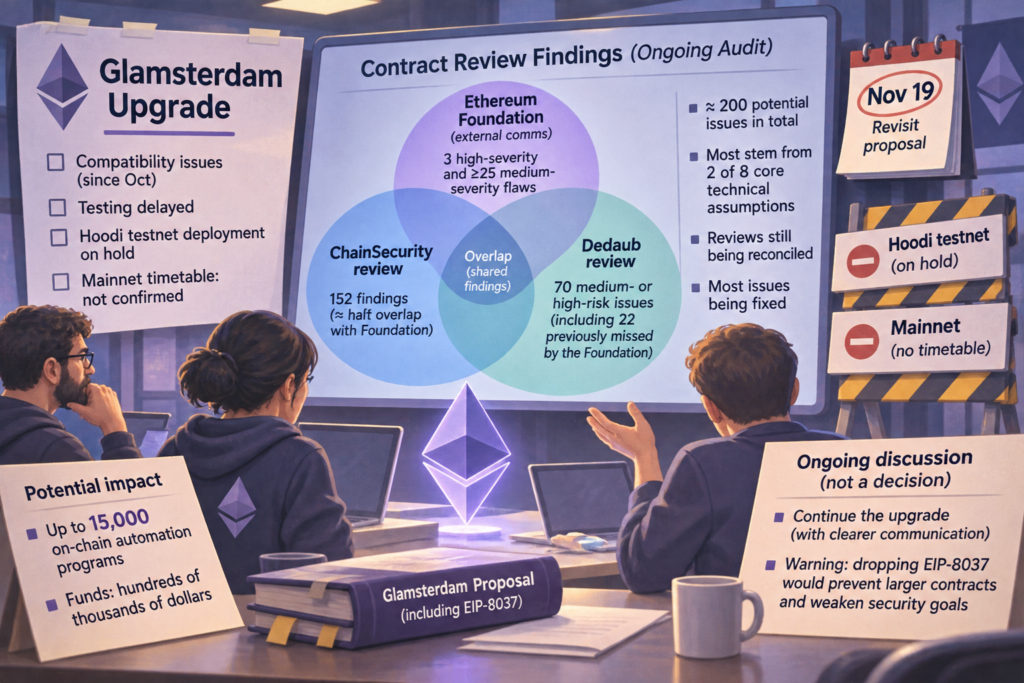
As reported on November 17, 2026, the planned Glamsterdam upgrade had no confirmed mainnet timetable. Compatibility concerns had delayed testing since October, and the Ethereum Foundation said deployment to the Hoodi public testnet would remain on hold until the issues were resolved. Core developers planned to revisit the proposal at their November 19 meeting.
At a November 16 developer call, Ethereum Foundation developer Marius van der Wijden said the planned upgrade could affect as many as 15,000 on-chain automation programs, according to CoinDesk. Funds associated with potentially affected contracts were estimated in the hundreds of thousands of dollars. The number of programs was far above what earlier reviews had identified.
The reviews were still being reconciled. ChainSecurity’s Tanguy Rocher reported 152 findings, about half of which overlapped with the Foundation’s internal research, for roughly 200 potential issues in total. In a separate review of approximately 25,000 contracts with unusual gas usage, Dedaub flagged 70 medium- or high-risk issues, including 22 the Foundation had previously missed. Most problems stemmed from two of the eight core technical assumptions about which the Foundation had warned developers on November 6. In its external communications, the Foundation identified three high-severity and at least 25 medium-severity flaws; most were being fixed.
The November 16 call ended without agreement. Researcher Ansgar Dietrichs, who helped write the proposal, argued for continuing the upgrade but acknowledged that core engineers needed to communicate more clearly with outside developers. Another participant warned that dropping EIP-8037 would prevent developers from deploying larger contracts and weaken the upgrade’s security goals. Those positions remained part of an unresolved discussion, not a decision to deploy the upgrade.