The U.S. House Financial Services Committee sent a rewritten version of H.R. 8957 to the full House on November 24, 2026. The bill would place eligible, federally owned bitcoin in a Treasury reserve and generally require it to be held for at least 20 years. It would not fund new purchases, and it would not put every bitcoin in a government-controlled wallet into the reserve.
The committee replaced the original text of the U.S. Reserve Modernization Act of 2026 and removed language from its long title about using Federal Reserve System resources to offset costs. The substitute and its accompanying report, No. 119-894, were placed on the Union Calendar as No. 789. That step did not schedule a floor vote or make the holding requirement law.
How much bitcoin would qualify?
The bill would reserve only bitcoin the federal government owns and that the law does not designate for another purpose. Sections 3(5) and 7(d) preserve the priority of Treasury and Justice Department forfeiture funds and applicable drug-forfeiture law. Victim restitution and required distributions to law enforcement would come before transfers to the reserve.
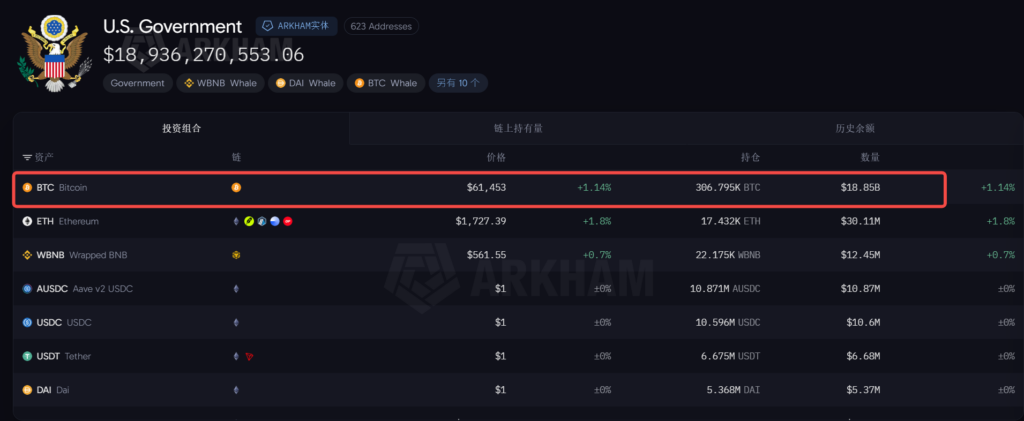
That distinction limits what can be inferred from wallet balances. In November 2026, Arkham attributed 306,795 BTC, valued at about $18.85 billion, to U.S. government addresses. CoinGecko’s broader estimate was 329,693 BTC, or about 1.57% of bitcoin supply. Its measure included assets still subject to civil forfeiture proceedings, such as the approximately 127,300 BTC involved in the Prince Group case.
Much of the tracked bitcoin came from enforcement cases, including those involving Silk Road and the Bitfinex hack. As of November 27, the White House had not published an audited inventory. Neither tracker’s figure establishes how much bitcoin would remain after ownership proceedings and restitution claims are settled.
Two Treasury accounts, with different rules
Within 180 days of enactment, Treasury would have to establish a Strategic Bitcoin Reserve and a separate Digital Asset Stockpile for other digital assets. Federal agencies would have 60 days to report their digital assets and would update those inventories annually. Disposals would generally be suspended during the transition, with exceptions for national security, legal requirements, court orders and victim restitution. Agencies would transfer eligible assets and ownership to Treasury within 30 days after the accounts were established.
For reserve bitcoin, Section 5 sets a minimum holding period of 20 years from enactment and bars sales, exchanges, auctions and pledges during that period. Two years before it ends, Treasury would have to recommend whether to keep holding or release bitcoin gradually. Any recommended sales after the holding period would be capped at 10% of the reserve per two-year period, taking the federal deficit, market impact and diversification into account. The bill does not require a sale at year 20.
Section 6 would require Treasury to publish annual cryptographic proof of reserves covering aggregate holdings, transactions and control of private keys. An independent cryptographic auditor would verify the disclosures, with periodic oversight by the U.S. comptroller general.
The proposed lock is not unambiguous. Sections 4(d)(3)(A) and 4(f)(2) retain sale authority if the Treasury secretary determines that a sale serves U.S. interests and issues public rules disclosing the scheduling method and maximum amount. How that authority would operate alongside Section 5’s prohibition remains unresolved. Section 5(d) would also require a report within one year on possible early-sale conditions, including national security and financial stability exceptions. A requirement to study those exceptions would not itself activate them.
Non-bitcoin assets in the stockpile would face neither the 20-year lock nor the reserve’s mandatory cryptographic audit. Treasury could sell them after public rulemaking. Proceeds would first cover operating costs for both accounts; any remainder would go toward reducing federal debt.
Forks and airdrops would have a separate one-year holding period. Afterward, Treasury would retain the dominant chain’s asset, identified by the highest publicly traded market capitalization. It could sell assets from less significant forks unless the Commerce Department and industry experts identified a distinct strategic use.
A study of purchases, not a purchase mandate
Section 9 would give the Treasury and Commerce secretaries 180 days after enactment to report to the Senate Banking and Finance committees and the House Financial Services and Ways and Means committees on budget-neutral ways to acquire more bitcoin. One option they would assess is selling or exchanging non-bitcoin assets in the stockpile.
To qualify, an approach could not increase federal debt in nominal or real terms, require a new appropriation or impose a net cost on taxpayers or federal agencies. Section 9(d) specifies that the act would not authorize borrowing, financing, pledging U.S. assets as collateral, raising taxes or deficit spending to buy bitcoin.
Section 10 also limits the bill’s reach over private holdings. It would prohibit the federal government from using the act to confiscate or infringe on digital assets lawfully held by individuals or institutions. Separately, a nonbinding sense-of-Congress provision describes self-custody of private keys as important to financial sovereignty, privacy and individual liberty.
The congressional deadline
Rep. Nicholas J. Begich, an Alaska Republican, introduced H.R. 8957 on May 21, 2026, with 21 original cosponsors, including Maine Democrat Jared Golden. Byron Donalds and Maria Elvira Salazar joined on November 24, bringing the total to 23. Despite that bipartisan sponsorship, the committee’s September 16 vote was 28–21 along party lines, with all 21 opposing votes from Democrats.
The bill still faced House floor procedures and a House vote, followed by Senate passage of identical text and presidential signature. Unfinished legislation would lapse when the 119th Congress ended on January 3, 2027. Democrats won control of both chambers in the November 3 midterm elections and were set to take control in the 120th Congress.
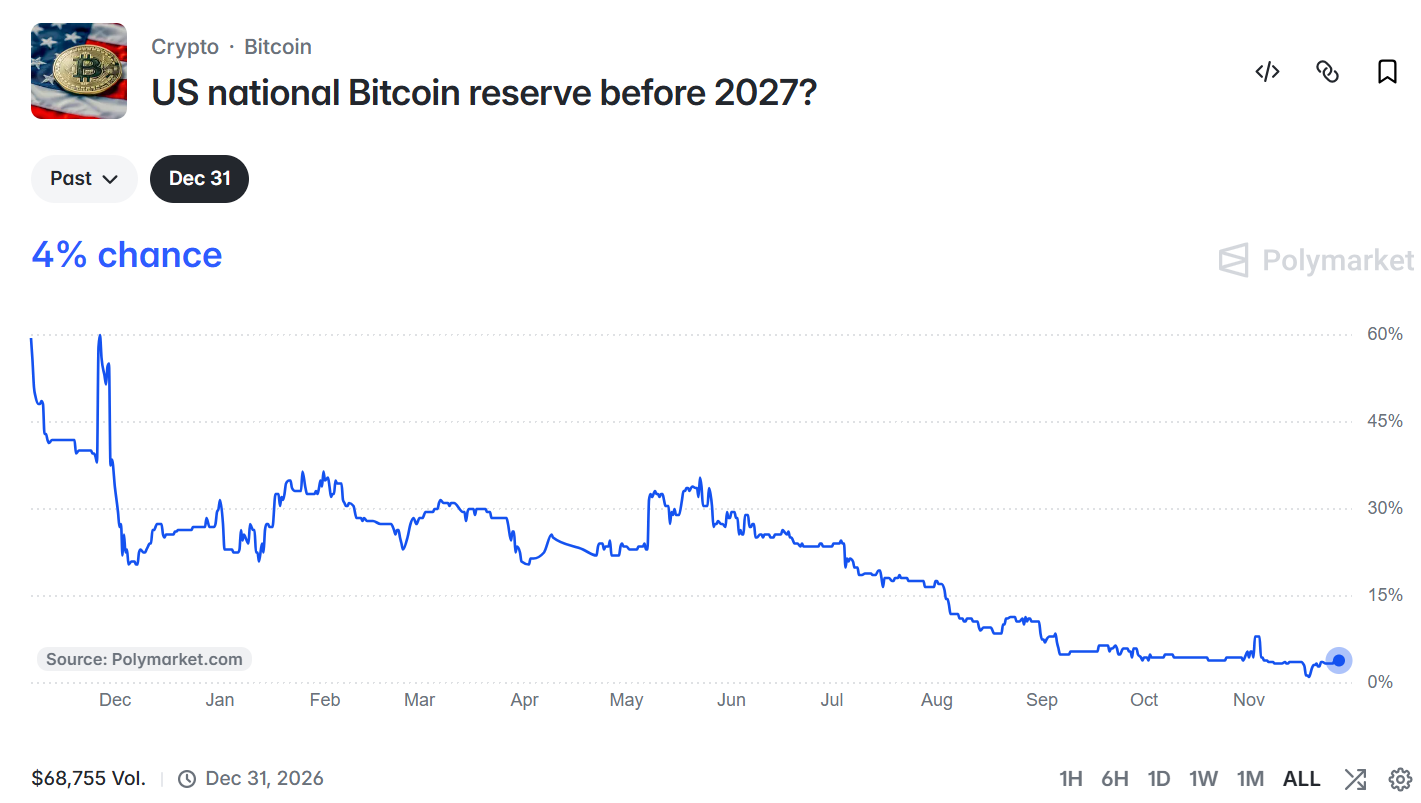
As of November 27, a Polymarket contract on whether the United States would establish a national bitcoin reserve before 2027 priced “Yes” at about 4%, down from 34% when the bill was introduced in May. The contract had recorded only about $68,800 in trading volume, and its settlement criteria did not match passage of H.R. 8957. Its price was not a direct estimate of the bill’s chances.