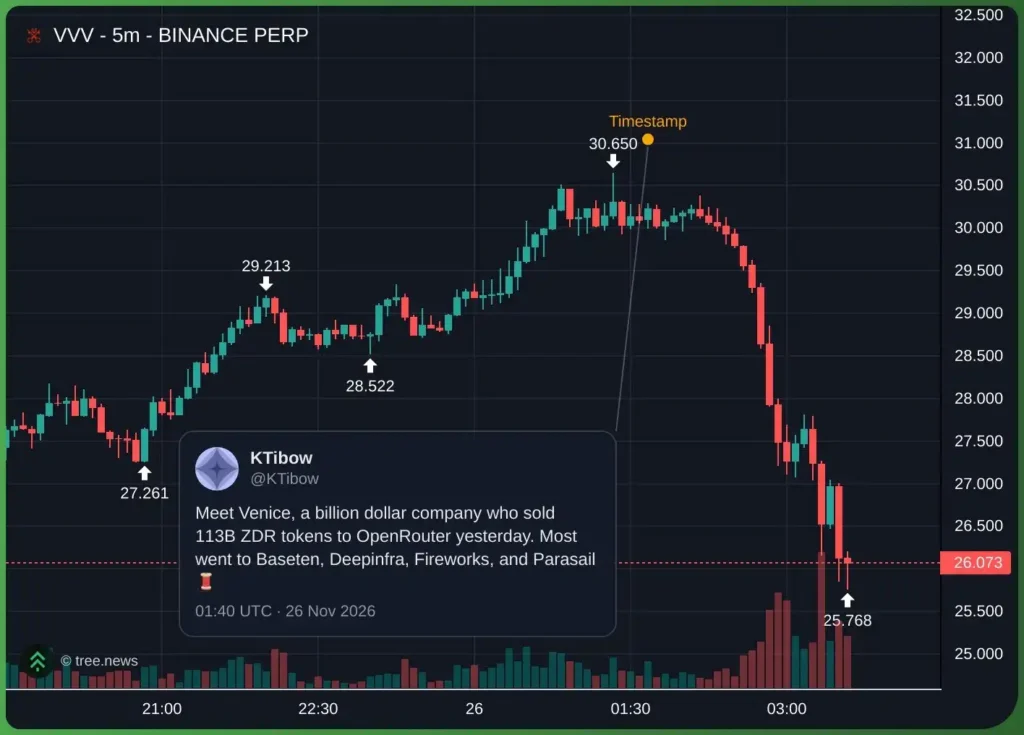
On November 26, 2026, KTibow published tests questioning how clearly Venice, an AI service, tells users who processes their chats. Founder Erik Voorhees acknowledged that some descriptions of models as self-hosted were out of date. He disputed a separate claim about encrypted chats, saying no one had demonstrated that Venice could read them.
The November 27, 2026 report, published at 10:13 UTC+8, put VVV’s decline at about 15%: the token traded as low as roughly $25.80 after trading above $30. It had gained about 33% in the preceding week despite weakness in the broader market.
What the hosting tests showed
KTibow sent image links to 18 models available through Venice and checked which servers retrieved the images. For 14 models, KTibow reported requests from outside providers including Baseten and DeepInfra. The finding called into question wording on some Venice pages that said models ran on servers it hosted. The requests indicated that outside companies participated in processing; they did not establish that those companies retained conversations.
Voorhees said Venice had added hosting partners as its business grew. Some models still ran on servers Venice controlled, he said, while partners operated others under agreements to use prompts only to produce the requested response and not to retain either the prompt or the reply.
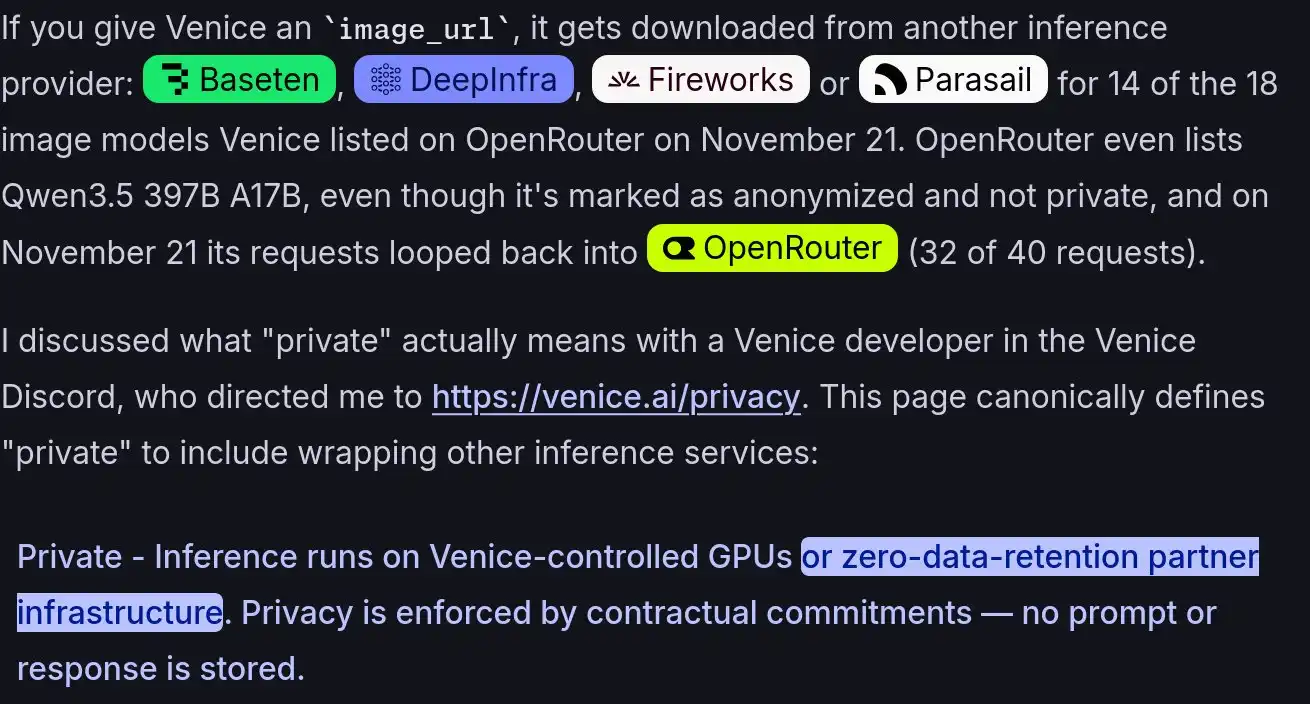
A promise not to retain a chat is different from an inability to read it
The distinction depends on which Venice mode a user selects:
- Anonymous mode: Venice forwards the prompt without the user’s account identity. The model provider can still read the prompt.
- Standard private mode: Venice or a partner processes the conversation and undertakes not to retain the prompt or response.
- Trusted execution environment (TEE) mode: The model runs in a hardware-isolated environment designed to prevent the server operator from inspecting content during processing.
- End-to-end encrypted mode: Messages are encrypted on the user’s device. Venice relays the ciphertext, and the messages are decrypted for processing inside a verified, isolated environment.
KTibow questioned whether some older encryption flows could allow an intermediary to recover earlier conversation content. Voorhees said no one had demonstrated such an attack and asked researchers to submit any specific vulnerability to the relevant Phala or NEAR team. Dragonfly investor Tom Schmidt criticized KTibow for omitting the differences among the four modes.
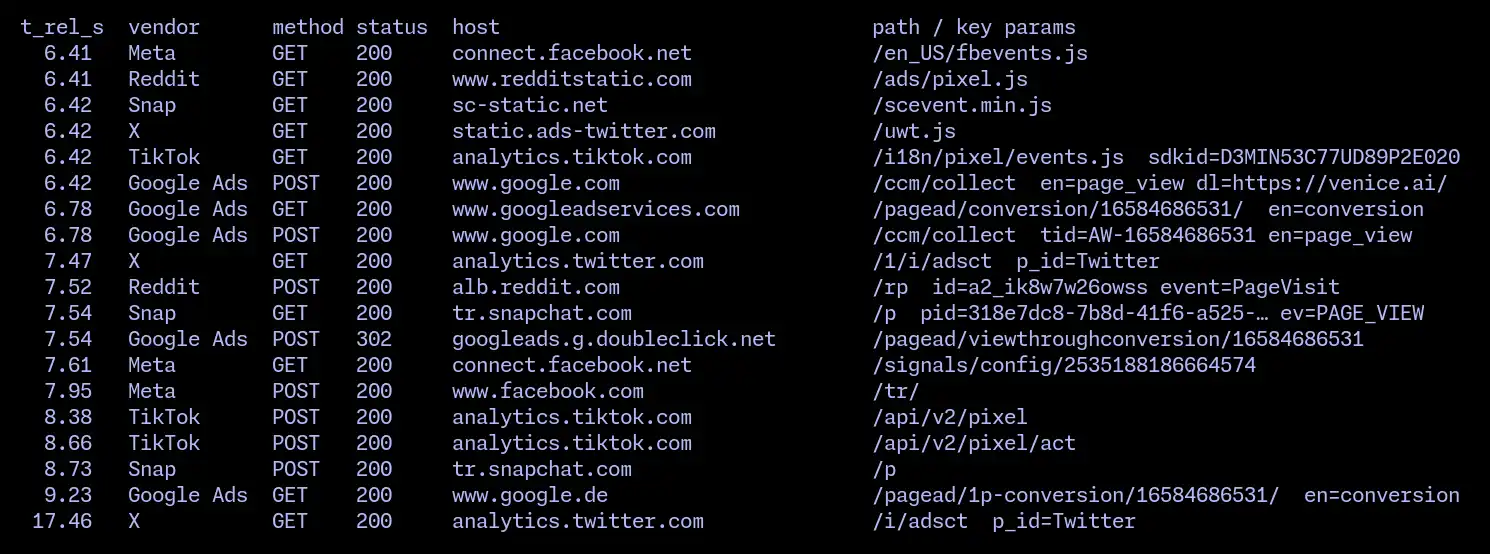
KTibow also showed records of the Venice homepage sending tracking requests to advertising platforms including Meta, Google and TikTok. Those records concerned visits to the homepage, not the contents of encrypted chats.
How AI usage connects to VVV
Venice gives consumers a single interface for multiple AI models and gives developers access through an API. In May, Delphi Digital co-founder Yan Liberman identified potential users ranging from professionals handling sensitive material to journalists working in high-risk settings and people seeking fewer content restrictions. He pointed to integrations with OpenRouter, Fleek and Brave Leo as evidence that Venice was expanding beyond its own chat interface to supply model inference to other applications.
Liberman estimated that new subscriptions from April 26 to May 2 represented about $1.9 million in annualized revenue, compared with about $2.6 million for subscriptions added from May 10 to 16. He estimated Venice’s overall annualized revenue at about $60 million in May. Voorhees announced a $100 million annualized rate on August 17; the reported rate exceeded $200 million on November 23. These figures describe revenue at an annualized pace, not receipts collected over a full year.
Developers can secure recurring API credit through the token system. Users stake VVV to receive sVVV, then lock sVVV to mint DIEM. Each staked DIEM provides $1 in API credit per day. To recover the locked sVVV, the minter must burn the corresponding DIEM. Separately, under a plan announced in July, Venice pledged to use 5% of API credit sales to buy back and burn VVV.
Venice added another use for VVV with the November 17 launch of Minds. Creators can list task-specific AI agents on the Mind Market and charge a markup. They receive 90% of that markup in credits, while the platform uses the remaining 10% to buy back VVV. Users can also burn tokens to improve a Mind’s ranking.
Wallet transfers did not confirm a founder sale
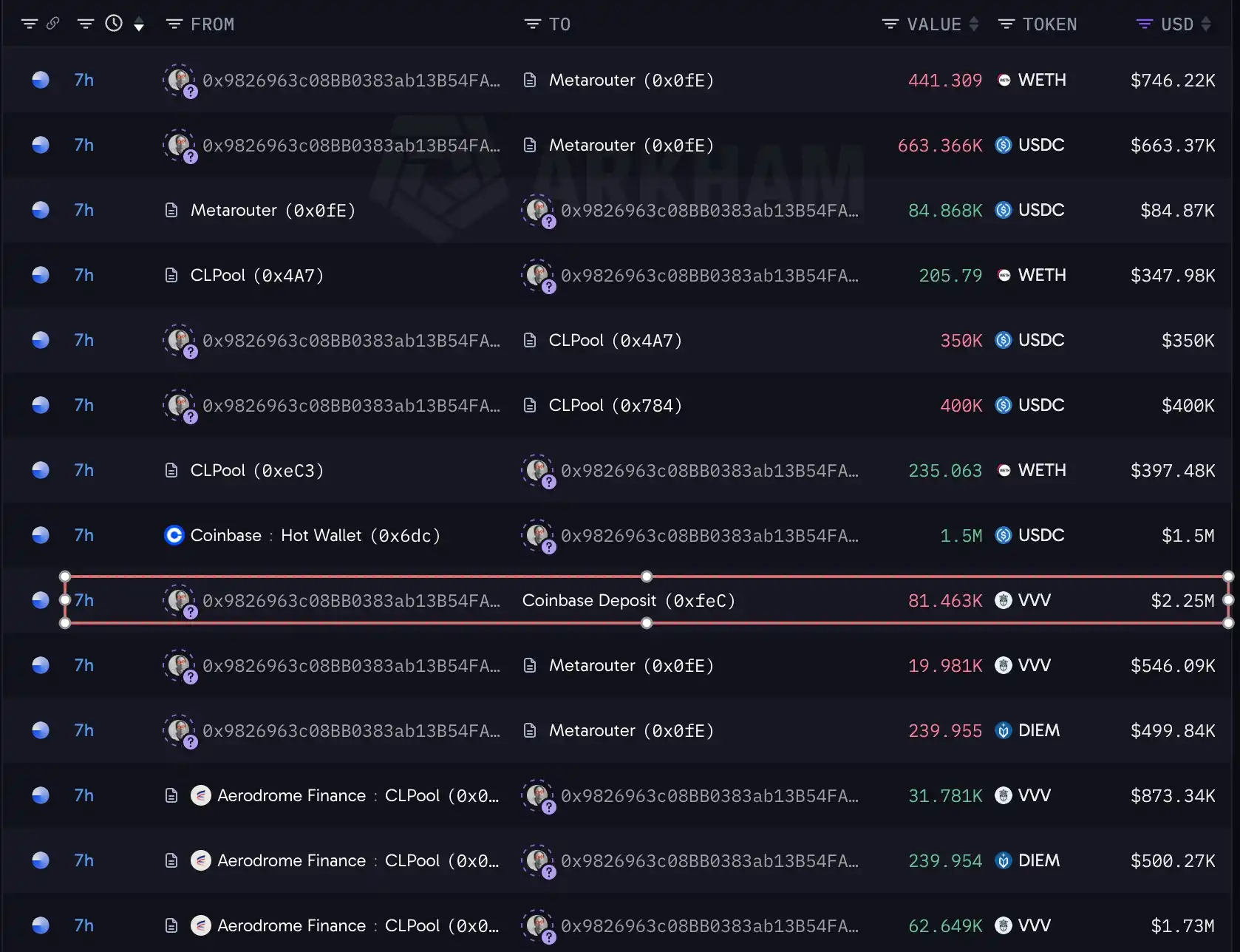
Lookonchain reported that a wallet it suspected was linked to Voorhees transferred 81,463 VVV to Coinbase, worth about $2.25 million at the time. The wallet still had approximately 675,000 VVV staked when Lookonchain observed it. Neither the suspected wallet link nor the exchange deposit established that Voorhees sold tokens.
Two other large wallets had requested withdrawals from staking before KTibow’s post. A wallet beginning with 0x331c requested to unstake roughly 200,000 VVV on November 23, and one beginning with 0x6776 requested to unstake about 500,000 VVV on November 24. Neither request confirmed a sale.