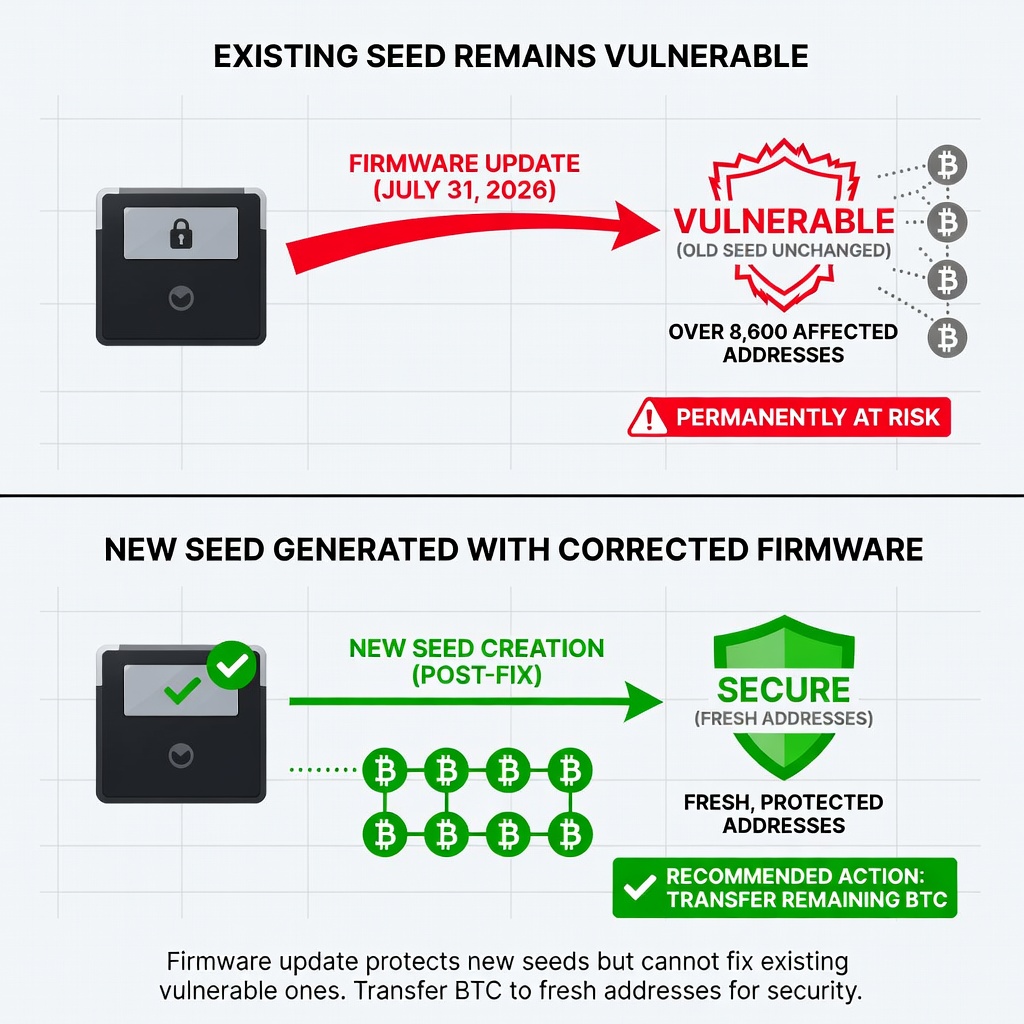
Attackers reconstructed Bitcoin private keys offline without accessing owners’ Coldcard hardware wallets, according to Coinkite’s 18-page postmortem. The manufacturer traced the theft of 1,778.84 BTC to a firmware defect that made some recovery seeds more predictable than intended. Its July 31, 2026 firmware fix protects newly generated seeds but cannot strengthen seeds created under the defective configuration.
How the defect escaped review
Coinkite said it introduced the error while integrating a software library in March 2021. When generating recovery seeds, the firmware used a software-based pseudorandom number generator instead of the intended hardware random number generator.
Coinkite estimated that affected Mk2 and Mk3 wallets generated seeds with about 40 bits of effective entropy, a measure of unpredictability. It put the figure for affected Mk4, Mk5 and Q wallets at about 72 bits, against a target of 128 bits. Coinkite documented at least 15 independent security reviews and research efforts between 2021 and 2026, including firmware examinations and automated tests. None identified the configuration error before attackers began exploiting it on July 29, 2026.
What the loss figures establish
Galaxy Research confirmed losses across more than 8,600 Bitcoin addresses through blockchain analysis and direct communication with 190 victims. Its August assessment valued the stolen bitcoin at about $112.7 million and excluded several additional suspected thefts. The reported 1,778.84 BTC was worth about $107 million at prices cited in the November 25, 2026 report.
The address count is not a victim count: one seed can generate multiple addresses. By November 18, Coinkite had received 300 loss-related support tickets tied to 242 accounts, or about 0.21% of its estimated customer base. The total number of victims remained unclear.
What the firmware fix changes
Coinkite released corrected firmware across all supported release tracks on July 31. Later updates added randomness sources, required user input and strengthened verification controls. Independent security firm Keylabs confirmed the seed-generation fix was effective within the scope of its review. Because installing the update does not change an existing seed, Coinkite recommends that affected owners generate a new seed with corrected firmware and transfer their remaining bitcoin to fresh addresses.
Galaxy researcher Alex Thorn traced 52.37 BTC in recovered funds to wallets associated with the incident. Affected owners can submit ownership claims through Crypto Recovery Trust. As of the November report, Coinkite had implemented 12 security recommendations, with three outstanding. It had neither identified the attackers nor finalized a compensation plan.