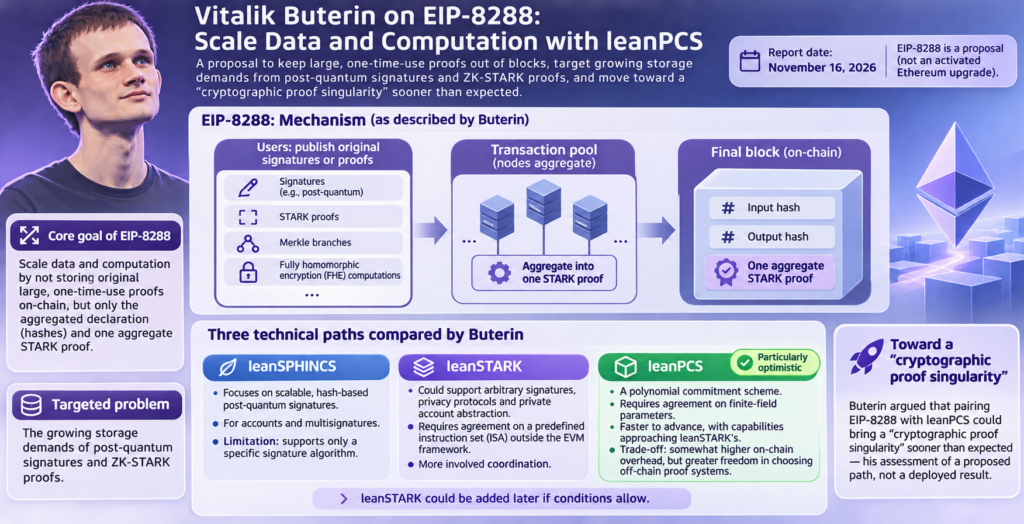
In a report published on November 16, 2026, Vitalik Buterin described EIP-8288 as a proposal to scale data and computation by keeping large, one-time-use proofs out of blocks. He said he had become particularly optimistic about leanPCS as a route to implementing it. The proposal was not described as an activated Ethereum upgrade.
Under the mechanism Buterin outlined, users would publish original signatures or proofs, and nodes would aggregate them into a STARK proof in the transaction pool. The final block would contain input and output hashes and one aggregate proof, rather than the original large proofs. The approach targets the growing storage demands of post-quantum signatures and ZK-STARK proofs; the examples given include signatures, STARK proofs, Merkle branches and fully homomorphic encryption computations.
Buterin compared three possible technical paths:
- leanSPHINCS focuses on scalable, hash-based post-quantum signatures for accounts and multisignatures, but supports only a specific signature algorithm.
- leanSTARK could support arbitrary signatures, privacy protocols and private account abstraction. It would, however, require agreement on a predefined instruction set outside the EVM framework, making coordination more involved.
- leanPCS, a polynomial commitment scheme, would require agreement on finite-field parameters. Buterin presented it as faster to advance, with capabilities approaching leanSTARK’s. He noted a trade-off: somewhat higher on-chain overhead, but greater freedom in choosing off-chain proof systems. leanSTARK could be added later if conditions allow.
Buterin argued that pairing EIP-8288 with leanPCS could bring what he called a “cryptographic proof singularity” sooner than expected. That is his assessment of a proposed path, not a deployed result.