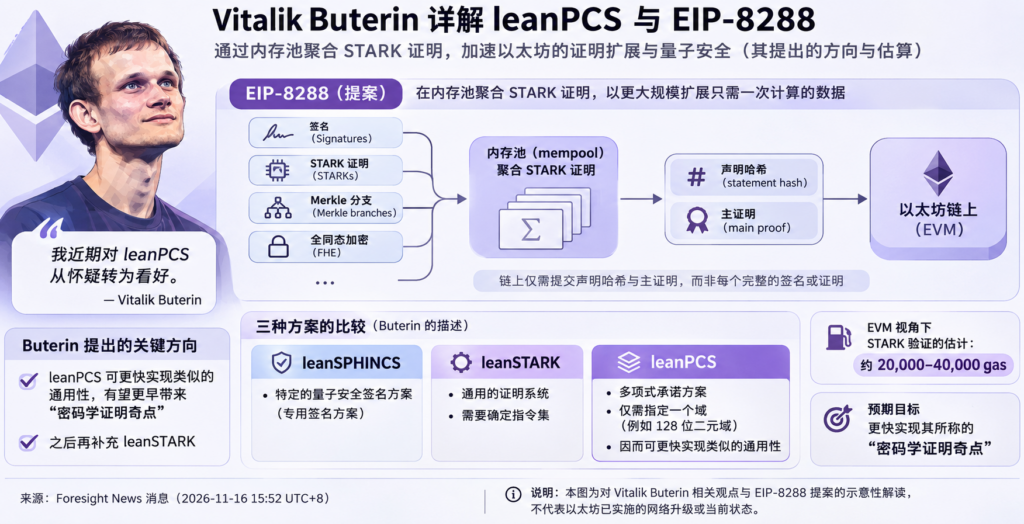
Originally reported by Foresight News on November 16, 2026, at 15:52 (UTC+8). At the time, Vitalik Buterin said he had recently shifted from skepticism to optimism about leanPCS. His explanation connected it to EIP-8288, a proposal for scaling proof verification—not an upgrade the report said had been activated.
As Buterin described it, EIP-8288 would aggregate STARK proofs in the mempool so that computations needed only once—potentially involving signatures, STARKs, Merkle branches or fully homomorphic encryption (FHE)—could scale more broadly. The chain would receive a statement hash and a main proof, rather than every full signature or proof.
Buterin compared three approaches: leanSPHINCS, a specialized quantum-safe signature scheme; leanSTARK, a general-purpose proof system that requires an instruction set to be defined; and leanPCS, a polynomial commitment scheme. He said leanPCS needs only a specified field, such as a 128-bit binary field, and could therefore offer a faster route toward similar generality. From the EVM’s perspective, he estimated STARK verification at roughly 20,000–40,000 gas. He suggested leanPCS could bring what he called a “cryptographic proof singularity” sooner, with leanSTARK added later. These were his proposed direction and estimates, not reported network changes.
Source: foresightnews.pro (originally published 2026-11-16 15:52 UTC+8)