Historical report: originally published November 10, 2026, at 10:59 a.m. UTC+8.
At Devcon 8 in Mumbai, Ethereum Foundation researcher Justin Drake set out an aspirational goal of completing Ethereum’s post-quantum and “post-AI” transition by December 2028. That is a year earlier than the Foundation’s stated December 2029 target for three layers of post-quantum protection. The Foundation had said the 2029 date would not change before a review with external experts in January 2027. Neither date means the proposed changes have been activated.
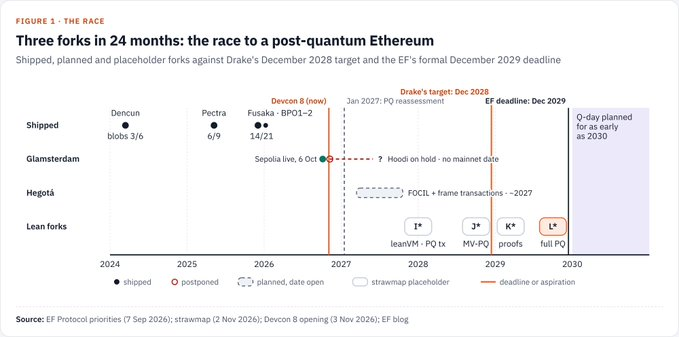
The immediate difficulty is upgrade delivery. The draft roadmap places Hegotá after Glamsterdam, followed by forks provisionally labelled I*, J*, K* and L*. Completing three forks in the 24 months after Glamsterdam would mean roughly one every eight months. The source contrasts that pace with recent intervals of 11, 14 and seven months.
What the proposed forks would change
Hegotá is not itself the post-quantum fork. Its proposed frame transactions, EIP-8141, would let accounts define their own authorization method—a route away from reliance on ECDSA without requiring a fork for every replacement signature scheme. Hegotá also includes FOCIL, EIP-7805, a proposed transaction-inclusion mechanism intended to make censorship harder.
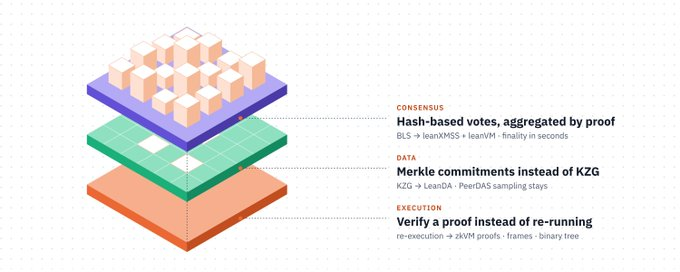
In the draft sequence, I* would introduce leanVM and post-quantum “lean” transactions. J* would add hash-based validator signatures and post-quantum data sampling, reaching what the Foundation calls a “minimum viable post-quantum” milestone. K* and L* would bring mandatory execution proofs and the remaining Lean architecture changes. These are roadmap proposals, not deployed network features.
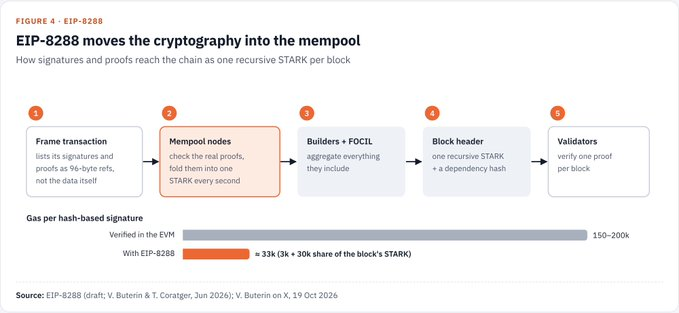
A separate draft, EIP-8288, would aggregate signatures and proofs in the mempool rather than put each large item on-chain. Transactions would carry references to the required data, while a recursive proof in the block would cover the dependencies. The proposal remains early: STARK dependencies are reserved but not yet enabled, some design choices are still marked undecided, and it has no scheduled fork. It also depends on frame transactions.
Why Glamsterdam matters to that sequence
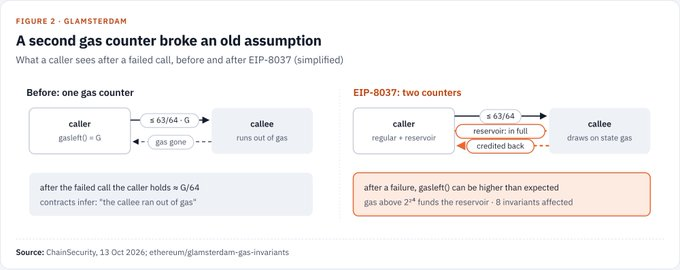
Glamsterdam’s testing exposed a compatibility problem in EIP-8037’s proposed gas repricing. ChainSecurity warned that its separate state-gas reserve could allow some contract error handlers to complete where they had previously run out of gas, bypassing checks those contracts relied on. The Foundation identified eight broken invariants, and an AllCoreDevs summary counted 13 affected DeFi projects.
Glamsterdam was withdrawn from a second testnet on October 22, 2026, and Hoodi testing was delayed without a new Hoodi or mainnet date in the original report. All Core Devs coordinator Nixo wrote that the issue would “very likely” push Glamsterdam mainnet deployment into 2027. That was an assessment, not a confirmed release date. The dependency matters beyond Glamsterdam because, according to the source, Hegotá’s frame-transaction work lists EIP-8037 as a requirement.
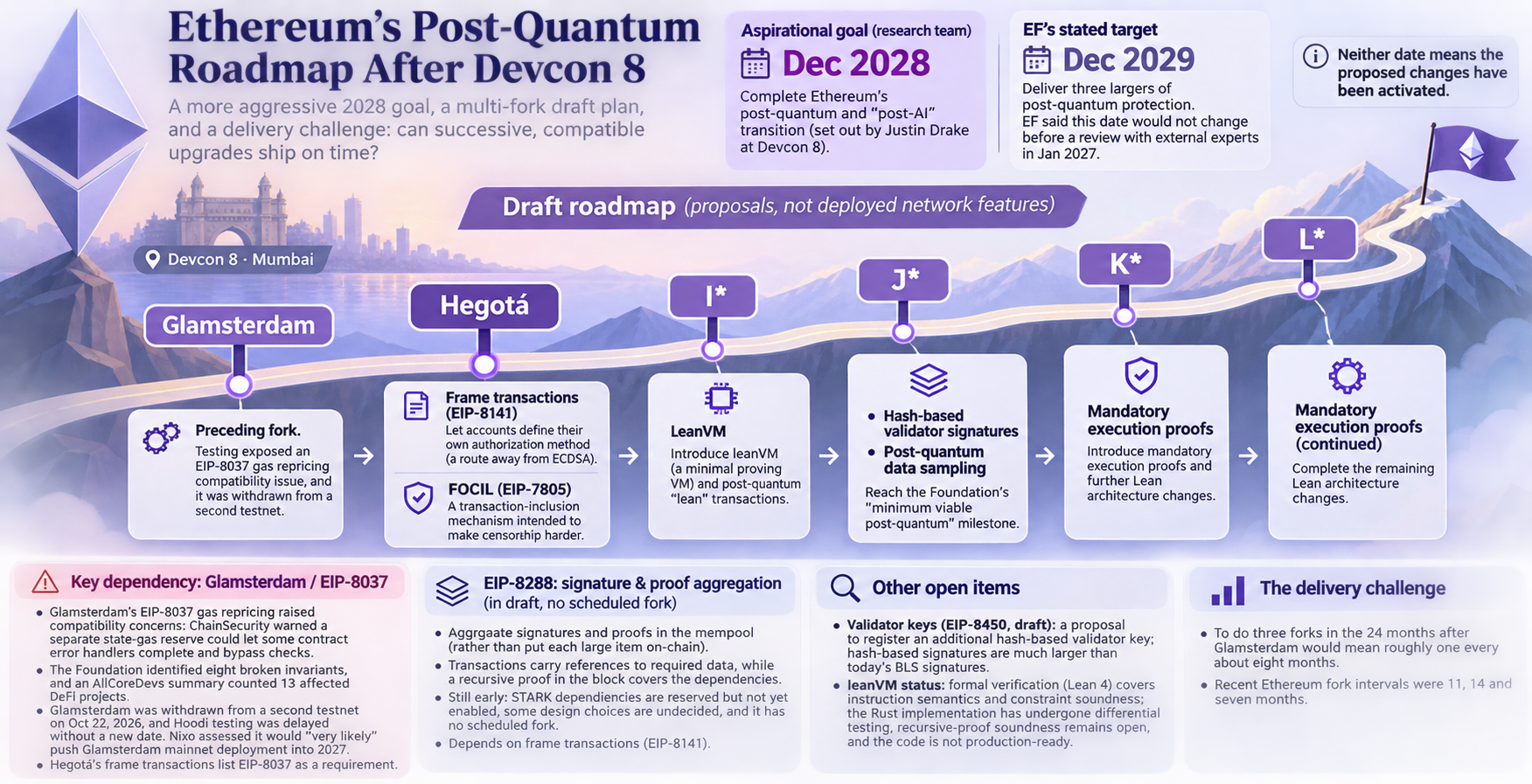
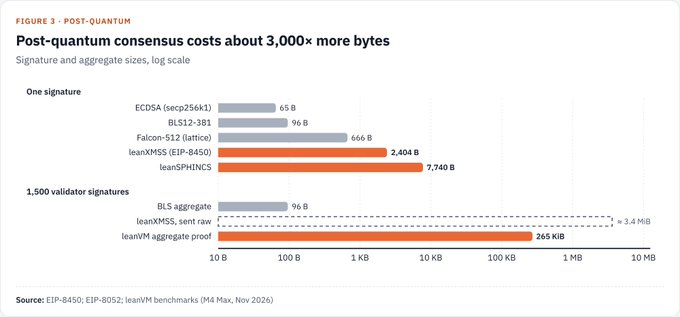
The post-quantum work has unresolved implementation questions, too. The source describes a draft validator-key registration proposal, EIP-8450, and notes that hash-based signatures are much larger than today’s BLS signatures. It also distinguishes a formal-verification announcement for leanVM from the work still outstanding: its Lean 4 work covers instruction semantics and constraint soundness, while the Rust implementation has undergone differential testing, recursive-proof soundness remains open, and the code is not production-ready.
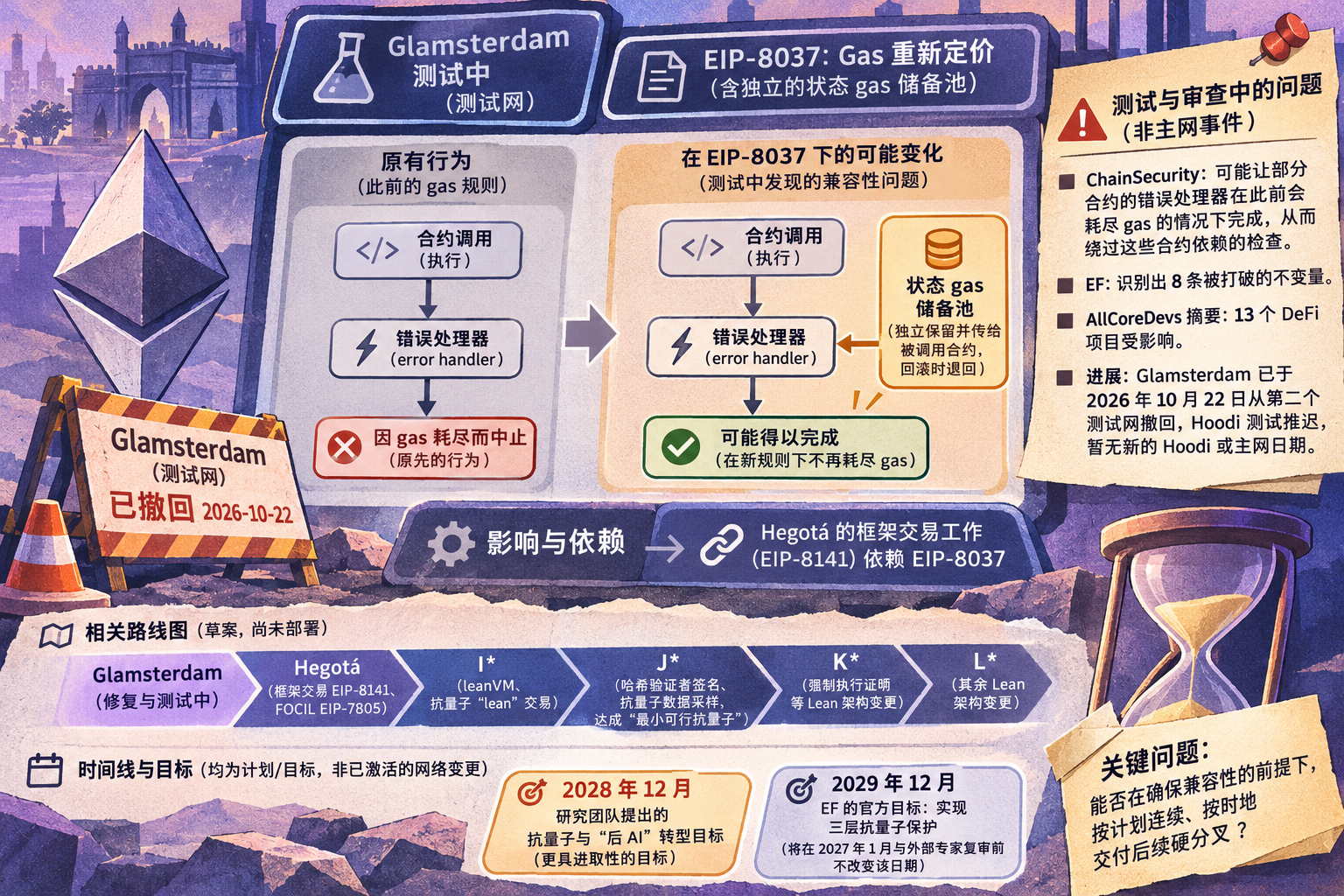
As of the original November 10 report, the next checkpoints included discussions of EIP-8037 and EIP-8038 fixes, a revised Hoodi test date, and the January 2027 review of the Foundation’s timeline. The central question was not whether a post-quantum design could be described, but whether successive, compatible hard forks could deliver it on the proposed schedule.
Source: panewslab.com (originally published 2026-11-10 10:59 UTC+8)