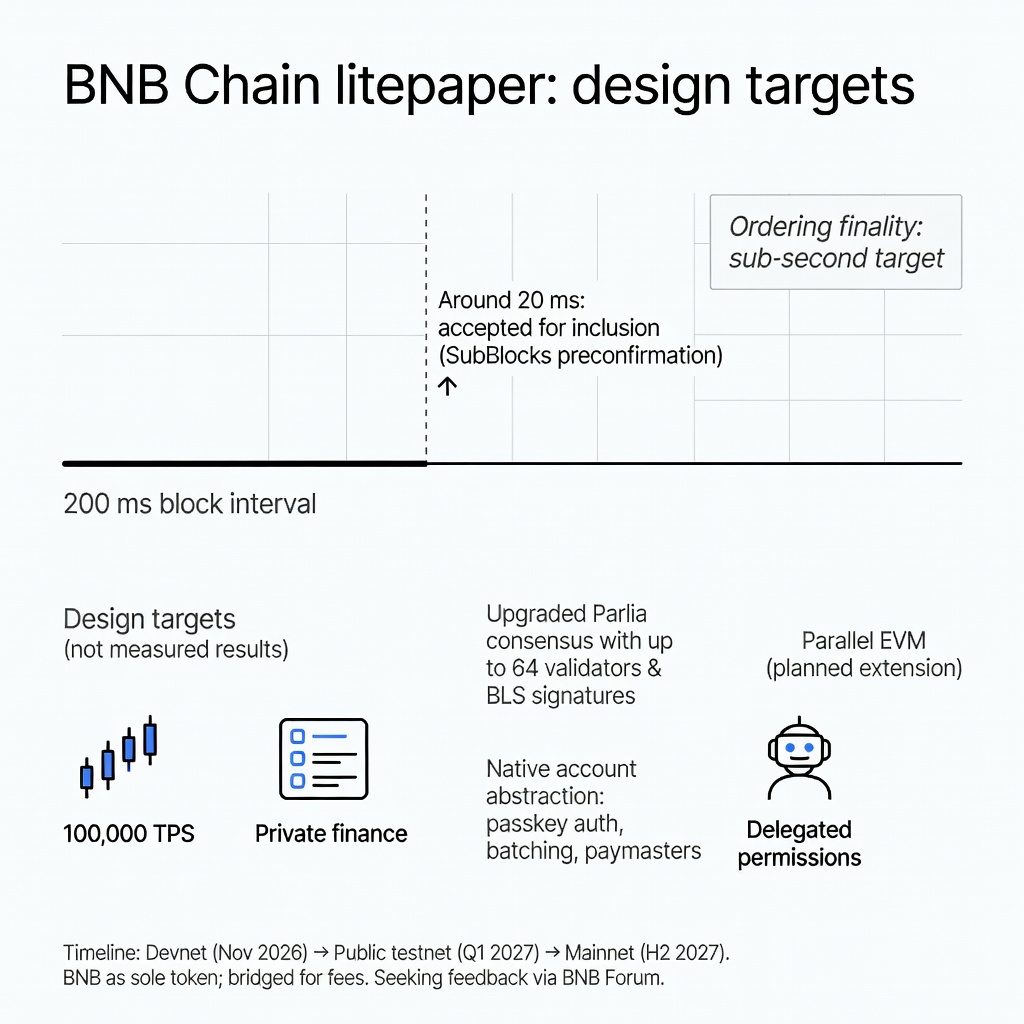
On November 26, 2026, BNB Chain published a litepaper for a Layer 1 blockchain that would run alongside BNB Smart Chain (BSC). The proposed network is compatible with the Ethereum Virtual Machine (EVM) and is designed for high-frequency trading, real-time payments, private finance and autonomous AI agents. It would use BNB for gas, staking and governance rather than introduce a second native token. Users would be able to bridge BNB to the new chain to pay fees.
As of November 27, 2026, the network was running on a development network, or devnet. BNB Chain was targeting a public testnet in the first quarter of 2027 and expected mainnet in the second half of 2027. The litepaper builds on a technology roadmap released in the second half of 2026, and the team was seeking developer feedback through the BNB Forum.
What a 20 ms preconfirmation would tell a trader
For a market maker updating a quote, the first useful signal is whether the chain has accepted the transaction for inclusion. A mechanism called SubBlocks aims to provide that signal in about 20 milliseconds, before the full block closes. That preconfirmation is distinct from finality on transaction ordering. The litepaper targets 200 ms block intervals, sub-second ordering finality and throughput of 100,000 transactions per second. These are design targets, not measured mainnet results.
BNB Chain also proposes dedicated capacity lanes for tasks such as quote updates and payment authorizations, so a burst of activity in one lane need not delay the other. The consensus design uses an upgraded version of Parlia, a proof-of-staked-authority system with up to 64 validators. BLS signatures let the network combine multiple validators’ signatures into one compact proof. Parallel EVM execution, which would let non-conflicting transactions run side by side, is a planned extension rather than a launch feature.
Who pays fees and who can authorize transfers
The proposed chain includes native account abstraction, with support for passkey authentication, transaction batching and app-sponsored fees. An application could cover gas through a paymaster: the fee would still be paid in BNB, but the user would not need to hold BNB to authorize a payment.
For AI agents, the design lets an account owner delegate permission to transact, set limits on that authority and revoke it later. For BNB and BEP-20 token transfers, the litepaper proposes shielded settlement using zero-knowledge proofs. Transfer privacy would be optional, not the default.