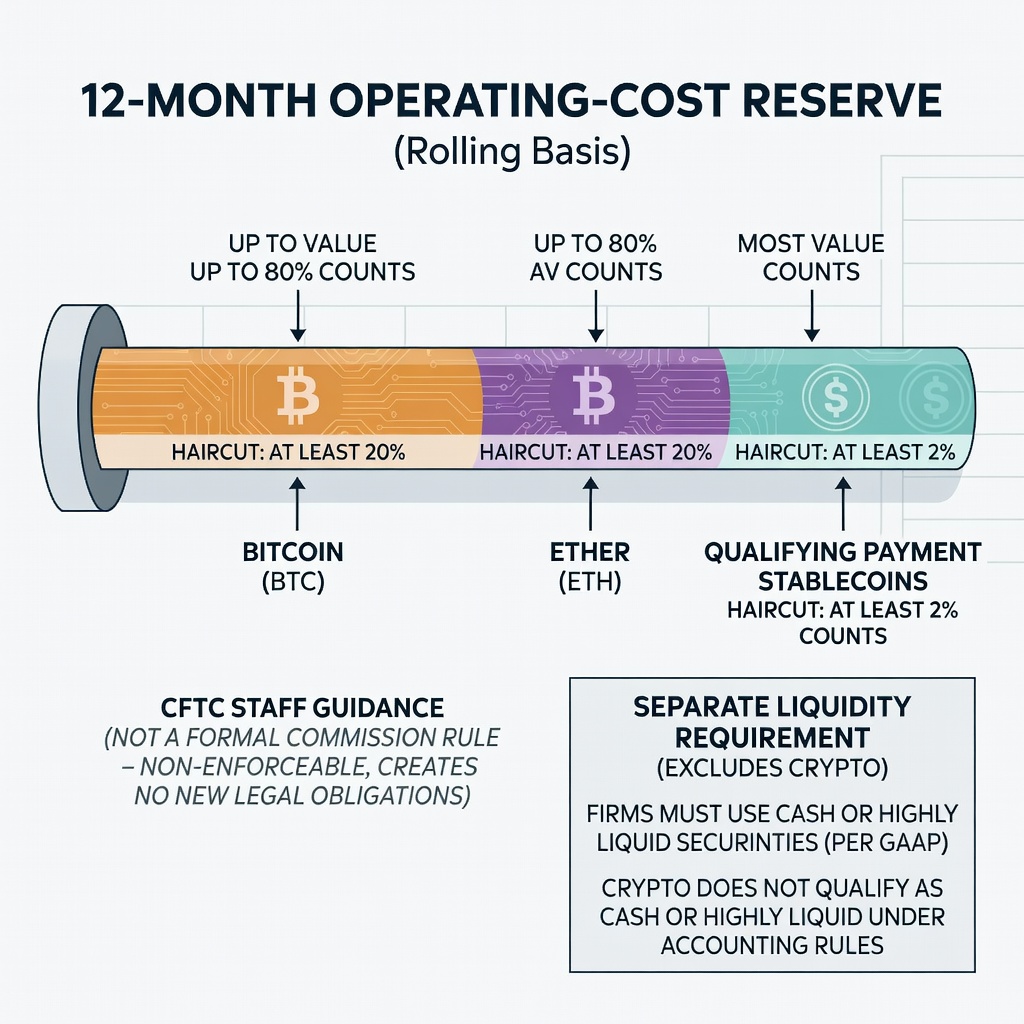
Staff at the US Commodity Futures Trading Commission issued an advisory on Monday on how regulated firms can meet reserve requirements. The Division of Market Oversight and the Division of Clearing and Risk said Bitcoin, Ether and payment stablecoins can count toward the rule on operating resources. The advisory is staff guidance. It is not a formal rule approved by the Commission, it creates no new legal obligations, and it is not enforceable.
What the operating-resources rule requires
CFTC rules require derivatives exchanges, swap trading venues and clearinghouses to hold enough financial resources to cover at least 12 months of operating costs on a rolling basis. The advisory clarifies that some crypto assets can fill part of that need. Those assets are counted only after a haircut, a discount to market value that accounts for the risk of losses.
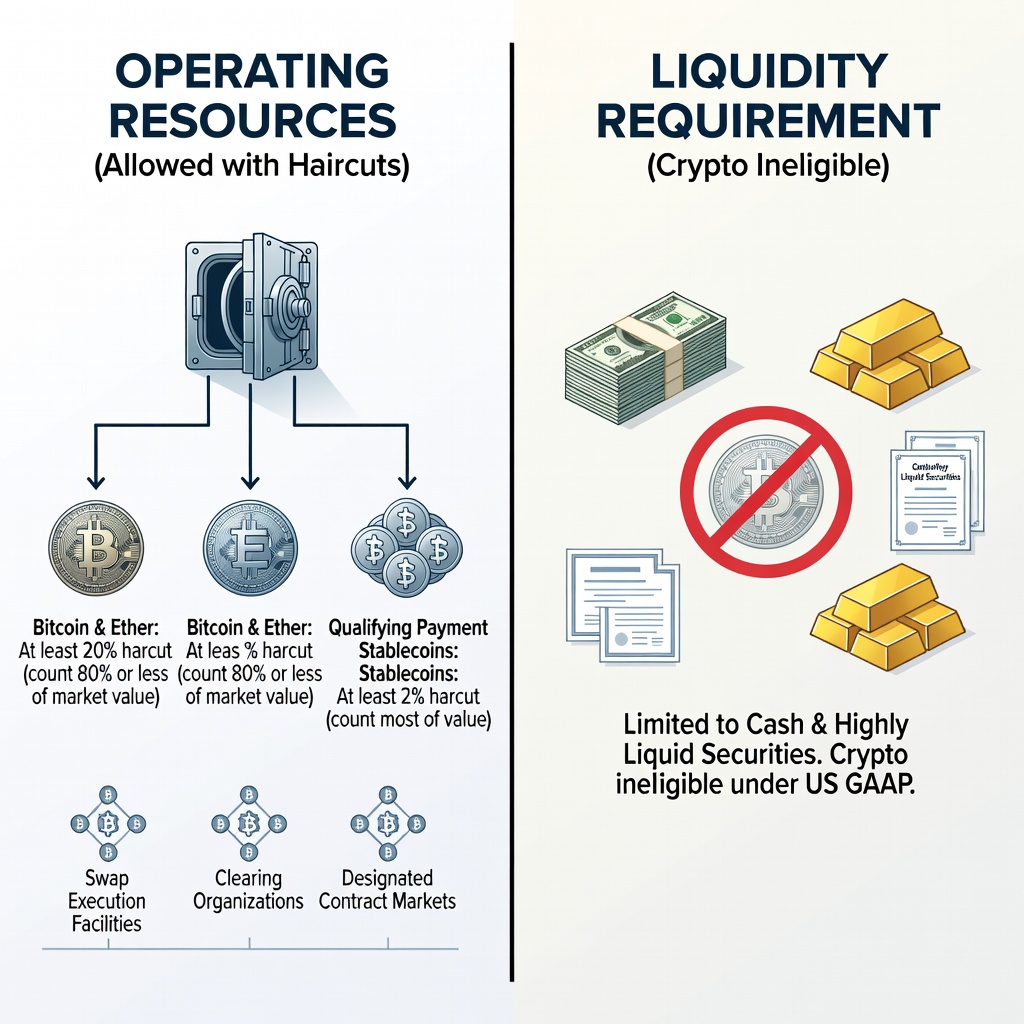
Staff said they would accept a haircut of at least 20% for Bitcoin and Ether, so a firm holding either asset can count 80% or less of its market value. Qualifying payment stablecoins face a smaller haircut of at least 2%, which means a firm holding them can count most of their value toward the requirement. The advisory does not name particular stablecoins.
The guidance applies to swap execution facilities, clearing organizations and designated contract markets. Firms in these groups include Coinbase Derivatives, Crypto.com’s North American Derivatives Exchange and Bitnomial Exchange. The prediction markets Kalshi and Polymarket US are also CFTC-regulated.
A separate liquidity test still excludes crypto
The guidance does not remove every requirement. Firms must still meet a separate liquidity requirement with assets such as cash or highly liquid securities. The CFTC noted that crypto does not qualify as cash or highly liquid securities under Generally Accepted Accounting Principles, the accounting rules US companies use to report their finances. For that reason, crypto cannot count toward the liquidity requirement.
How the advisory was described
CFTC Chair Michael Selig welcomed the advisory in a post on X. He said he was pleased to see staff continue to provide clarity around crypto assets in US derivatives markets, and he described the advisory as an important step.
Katherine Kirkpatrick Bos, head of legal at Chainlink Labs, called the advisory significant in her own post on X. She said one barrier to getting these licenses is the cost of holding large amounts of dollars, and that the guidance would help with that cost.
Final rule on event-contract reporting
The CFTC also took another step on Monday. It published a final rule creating a reporting framework for certain event contracts. The agency said rulemaking was needed because it had earlier used a no-action letter process. It said no-action letters do not carry the force of law, and that it wanted to standardize the data firms report. The final rule adds a new part that clarifies compliance dates; the announcement does not state those dates.
Selig said the CFTC will no longer regulate market participants through a patchwork of no-action letters. He described those letters as band-aids for unworkable regulations and called the final rule a step toward future-proofing the framework for event contracts. That reporting measure is a published final rule. The treatment of Bitcoin, Ether and payment stablecoins in operating reserves remains a non-binding staff advisory, not an activated Commission rule.